Handbook of Dimensional Measurement, Fourth Edition
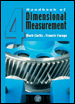
Chapter 9: Optical Projectors

OVERVIEW

The observation and measurement of objects with the aid of optical magnification is not limited to viewing through an ocular, such as used in the microscope. As mentioned in the preceding chapter, the magnified image of the object can also be projected on a glass screen, where it may be observed from a convenient distance. By the projection of the magnified image, the visual impression becomes a physical reality insofar as the dimensions and geometric forms, as they appear on the screen, can be directly compared to physical masters graduated rulers, templates and so forth made to the scale of the magnified specimen image.

Historically, the first optical projectors were developed shortly after World War I, for the purpose of checking the form of screw threading tools. However, the first projectors had several disadvantages, such as requiring a dark room for viewing, and the screen was too far away from the operator for the convenient comparison of the shadow image with a master chart. Subsequently, a mirror was inserted into the path of the projected shadow to reflect the image into the receiving screen in front of the operator. By enclosing the whole system in a housing and shielding the screen, the need for dark room operations was eliminated.

Although the prime users of the optical projectors were the manufacturers of threading tools and high quality threaded parts, the application of that new optical instrument did not long remain limited to a particular branch of the metalworking industry. The optical projector,...

UNLIMITED FREE
ACCESS
TO THE WORLD'S BEST IDEAS

SUBMIT
Already a GlobalSpec user? Log in.

This is embarrasing...

An error occurred while processing the form. Please try again in a few minutes.

Customize Your GlobalSpec Experience

Category: Projectors
Finish!
Privacy Policy

This is embarrasing...

An error occurred while processing the form. Please try again in a few minutes.