Handbook of Dimensional Measurement, Fourth Edition
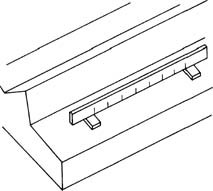
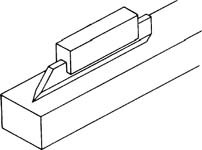
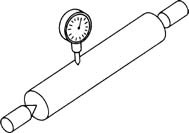
The straight line represents the path of all linear dimensions. Considering the premise that the shortest distance between two points is along a straight line, that path is not necessarily present in a physical sense on the part being measured for size, but it must be incorporated in the length measuring instrument. Straightness, which is a fundamental concept of linear measurements, is also a functionally important condition of many engineering products. As an introduction to the discussion of straightness measurements, a survey of a few basic methods is made in Table 11-2.
| OPERATING PRINCIPLES | TYPICAL INSTRUMENTS | DIAGRAM | DISCUSSION |
|---|---|---|---|
| Straightness of a surface element determined by its parallelism to a straight edge of known accuracy | Straight edge and gage blocks | | Unequal height of the supporting elements create a controlled deviation from true parallelism. Gage blocks are used to check whether the digressions from the parallel at intermediate points correspond to the calculated values. |
| The straightness of a surface element inspected by direct contact with a tool of calibrated straightness | Knife edge rule | | A knife edge rule brought to bear against the surface element to be inspected will indicate by the presence and width of light gaps the lack of contact caused by deficient straightness. |
| Straightness of a shaft determined by rotation on fixed supports and measuring the runout of its surface | Bench centers or Vee-blocks and indicator stand | | Using the part's axis (between centers) or its surface... |