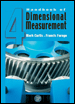
Handbook of Dimensional Measurement, Fourth Edition
Dimensional measurements provide the information needed to control all metalworking processes by which specific forms and sizes are imparted to the workpiece. The connection between dimensional measurement and the control of the metalworking process also usually involves evaluating the measurement results, decision-making regarding actions needed for correcting the detected imperfect condition, and performing the appropriate machine adjustments.
These functions, when carried out by the operator, must be aided by gages that readily supply work-size information with little or, preferably, no action on the part of the operator. In the high volume production of tightly toleranced parts on semiautomatic or fully automatic machine tools, the gaging must be complemented by the just enumerated supplementary functions, more specifically by
The evaluation of the momentary work size compared with the specified dimension and, optionally,
The operation of the appropriate machine controls for assuring that the workpiece size is in compliance with the pertinent specifications.
Gages that assist in assuring, or actually participate in controlling, the size of the processed workpiece are designated process control gages.
The need for machine adjustments to provide work-size control during processing depends on several circumstances, the specified dimensional tolerance of the part being an important factor. When producing parts with high accuracy requirements, even on dependably functioning machine tools, some degree of work-size control during machining might be needed, for any or several of the following reasons:
Tool wear, particularly in the case of tools that are subjected to rapid wear, such as grinding wheels;
Thermal deformation...