Geometric Transformations for 3D Modeling
Written from a mathematical standpoint accessible to students, teachers, and professionals, this text provides a comprehensive introduction to the theory and application of transformations.
 TABLE OF CONTENTS
 Systems of linear equations, the Einstein convention, matrices and linear transformations, singular and nonsingular transformations
Rigid-body, general affine and projective transformations we express algebraically as systems of linear equations. In this section, we review the forms and properties of these equations, their direct relationship to matrix algebra, and their role in describing geometric transformations. Our modus operandi is to show that linear transformations do indeed constitute a group and, therefore, meet the qualifications we discussed in the previous section.
A set of equations of the form
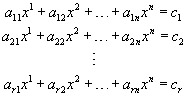
is a system of linear equations in the n unknowns x 1, x 2, , x n. The number of equations in this system is r, where r may be less than, equal to, or greater than n. For the present, we assume that the coefficients a ij and the constants c i are real numbers. If all the c i = 0, then we have a system of homogeneous linear equations.
Here is an alternative notation scheme for a system of linear equations that is simple:
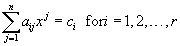
The so-called Einstein convention recognizes the presence of a repeated index in a term to indicate summation and assumes that r = n, unless otherwise indicated. We ordinarily work in two- or three-dimensional space, so n = 2 or 3. Using the Einstein convention for a system of homogeneous linear equations, we write

What...