Geometric Transformations for 3D Modeling
Written from a mathematical standpoint accessible to students, teachers, and professionals, this text provides a comprehensive introduction to the theory and application of transformations.
 TABLE OF CONTENTS
 The equations of projective transformations, central projection of a plane figure, central projection of a figure in space
After studying affine transformations, it must seem that not many invariant geometric properties are left to be given up to further generalizations. But of course there are, and the most important is that of parallelism. Affine transformations preserve parallelism, projective transformations do not.
We find the roots of projective geometry in the work of the artists and architects of the fifteenth century. Brunelleschi, an Italian architect of that era, was probably the first to discuss a theory of perspective drawing and its geometric interpretation and implications. Mathematics done over the next four hundred years added to and refined these few early theorems. Then, in the late nineteenth century, Felix Klein created a firm algebraic foundation for what we now call projective geometry.
Although the principles of projective geometry apply to a space of any dimension, we will limit our initial explorations to plane projective geometry. Here we begin to study the geometric properties of figures that are invariant under what we call central projection.
Projective geometry is the most universal of all the geometries that are characterized by linear transformations. It is the study of properties invariant under linear fractional transformations. The following rather formidable equations produce a projective transformation, or projectivity, in three-dimensional space:
| (2.33) | 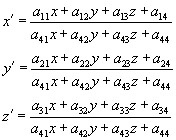 |
where for every point x,y,z there is a corresponding point x',y',z'. There are two important restrictions on...