Geometric Transformations for 3D Modeling
Written from a mathematical standpoint accessible to students, teachers, and professionals, this text provides a comprehensive introduction to the theory and application of transformations.
 TABLE OF CONTENTS
 Simple isometries, reflections in the plane, reflections in a line, reflection is orientation-reversing, inversion in a point and halfurns in the plane, the product of two halfturns, the product of three halfturns, the product of two reflections in the plane, the product of three or more reflections in the plane, glide reflection, isometries in space, the group of isometries, rotation followed by translation
An isometry (from the Greek isos and metron equal measure) is a rigid-body motion of the points of a geometric figure. The defining property of an isometry is that it preserves distances between points on the figure. If an isometry ? maps points P and Q to P' and Q', then PQ = P'Q' (Figure 2.26). In other words, a transformation ? is an isometry if P' = ?( P), Q' = ?( Q) and P'Q' = PQ.
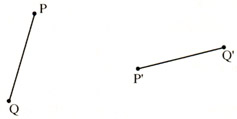
We often describe these transformations as motions or rigid-body motions because they resemble physical movements. The analogy is useful; however, remember no real motion is actually taking place, and there is no preferred path described for the transformation from P to P'. In fact, there is no path at all. Because these transformations preserve distance, it is easy to demonstrate that motions send each geometric figure into a congruent one, so sometimes we call them congruent transformations. Given an isometry ?