Geometric Transformations for 3D Modeling
Written from a mathematical standpoint accessible to students, teachers, and professionals, this text provides a comprehensive introduction to the theory and application of transformations.
 TABLE OF CONTENTS
 Affine deformation of a cube, affine geometry in the plane, shear, area-preserving shear transformation, strain, equiareal transformations, distance in affine geometry, the affine group, parallel projection
Our studies up to this point in the sequel are of classic elementary geometry, albeit from a new point of view. With affine geometry, we begin a subject first introduced in the eighteenth century by Leonhard Euler, a subject not usually part of school geometry. An affine property is one that is preserved by all affine transformations, but not by the more general projective transformations. Collinearity and parallelism are the two most important invariant properties of affinities.
Recall that isometries preserve distance between corresponding pairs of points in the plane or in space. Therefore, angles and other metric properties are invariant, and we obtain the familiar Euclidean geometry of congruent figures. When we give up the requirement that distances must be invariant but retain invariance of angles, the resulting linear substitutions are similarities. If we go one step further and give up both distance and angle invariance, then, algebraically, this means that we relax almost all of the earlier restrictions we placed upon the coefficients of the transformation equations. Consider the homogeneous linear transformation
| (2.19) | 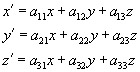 |
This time the only restriction we place on the coefficients is det a ij ? 0, or
| (2.20) | 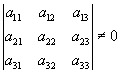 |
Equations 2.19 and the conditions placed on the coefficients by Equation 2.20 define an affine transformation or affinity. Note, we ignore the displacements parallel to the three coordinate...