Handbook of Machining and Metalworking Calculations
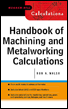
With easy-to-use tables, charts, listings, and formulas, this convenient hands-on resource will help you solve virtually any problem involving metalworking and machining tools and applications.
 TABLE OF CONTENTS
 The branch of metalworking known as sheet metal comprises a large and important element. Sheet metal parts are used in countless commercial and military products. Sheet metal parts are found on almost every product produced by the metalworking industries throughout the world.
Sheet metal gauges run from under 0.001 in to 0.500 in. Hot-rolled steel products can run from in thick to no. 18 gauge (0.0478 in) and still be considered sheet. Cold-rolled steel sheets are generally available from stock in sizes from 10 gauge (0.1345 in) down to 28 gauge (0.0148 in). Other sheet thicknesses are available as special-order mill-run products when the order is large enough. Large manufacturers who use vast tonnages of steel products, such as the automobile makers, switch-gear producers, and other sheet metal fabricators, may order their steel to their own specifications (composition, gauges, and physical properties).
The steel sheets are supplied in flat form or rolled into coils. Flat-form sheets are made to specific standard sizes unless ordered to special nonstandard dimensions.
The following sections show the methods used to calculate flat patterns for brake-bent or die-formed sheet metal parts. The later sections describe the geometry and instructions for laying out sheet metal developments and transitions. Also included are calculations for punching requirements of sheet metal parts and tooling requirements for punching and bending sheet metals.
Tables of sheet metal gauges and recommended bend radii and shear strengths for different metals and alloys are shown also.
The designer and tool engineer should...