Handbook of Petroleum Refining Processes, Third Edition

Joseph Gregor and Daniel Wei
UOP LLC
Des Plaines, Illinois
The UOP [*] Oleflex [*] process is catalytic dehydrogenation technology for the production of light olefins from their corresponding paraffin. An Oleflex unit can dehydrogenate propane, isobutane, normal butane, or isopentane feedstocks separately or as mixtures spanning two consecutive carbon numbers. This process was commercialized in 1990, and by 2002 more than 1,250,000 metric tons per year (MTA) of propylene and more than 2,800,000 MTA of isobutylene were produced from Oleflex units located throughout the world.
[*]Trademark and/or service mark of UOP.
The UOP Oleflex process is best described by separating the technology into three different sections:
Reactor section
Product recovery section
Catalyst regeneration section
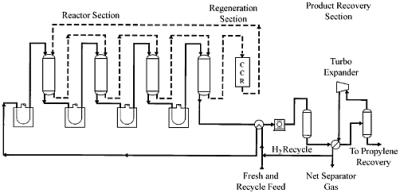
Hydrocarbon feed is mixed with hydrogen-rich recycle gas (Fig. 5.1.1). This combined feed is heated to the desired reactor inlet temperature and converted at high monoolefin selectivity in the reactors.
The reactor section consists of several radial-flow reactors, charge and interstage heaters, and a reactor feed-effluent heat exchanger. The diagram shows a unit with four reactors, which would be typical for a unit processing propane feed. Three reactors are used for butane or isopentane dehydrogenation. Three reactors are also used for blends of C 3-C 4 or C 4-C 5 feeds.
Because the reaction is endothermic, conversion is maintained...