Handbook of Petroleum Refining Processes, Third Edition

Alan G. Bridge [*]
ChevronTexaco Research and Technology Company
Richmond, California
Gary L. Hamilton
Chevron Lummus Global LLC
Bloomfield, New Jersey
[*]Deceased.
This chapter provides a historic perspective of the importance of hydrogen processing in the refining industry. The technologies referred to in this chapter are dealt with in greater detail in the respective technology chapters.
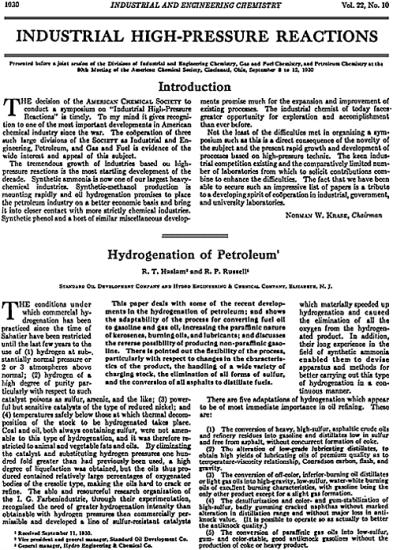
The potential for applying hydrogenation reactions within the refining industry has been known since the early years of the twentieth century. In October 1930 the American Chemical Society conducted a symposium in Cincinnati on the subject of Industrial HighPressure Reactions. In one of the papers, Haslam and Russell37 discussed the five adaptations of hydrogenation which appeared to be of the most immediate importance. Figure 14.1.1 is a copy of the page on which they summarized these five adaptations.
Horne and McAfee41 in 1958 noted that of these five, the second, third, and fourth were already being practiced, and they predicted that the first and fifth would also soon be commercialized. They were right. Such reactions are now commonplace in modern refineries, largely because of the plentiful supply of hydrogen produced either in catalytic reformers or from inexpensive sources of natural gas.
The modern version of distillate hydrocracking was introduced in the United States in the 1960s to convert excess fuel oil to predominantly motor gasoline and some jet fuel. Fluid catalytic cracking (FCC) cycle oils were popular...