Heat Transfer
Offering complex and timely real-world problems that are inherently interesting, this book provides engineers with the capability, tools, and confidence to solve real-world heat transfer problems.
 TABLE OF CONTENTS
 The generation of thermal energy within a conductive medium may occur through ohmic dissipation, chemical or nuclear reactions, or absorption of radiation. According to the first law of thermodynamics, energy cannot be generated (excluding nuclear reactions); however, it can be converted from other forms (e.g., electrical energy) to thermal energy. The energy balance that we use to solve these problems is then strictly a thermal energy conservation equation. The addition of thermal energy generation to the 1-D steadystate solutions considered in Section 1.2 is straightforward and the steps required to obtain an analytical solution are essentially the same.
Consider a plane wall with temperatures fixed at either edge that experiences a volumetric generation of thermal energy, as shown in Figure 1-7.
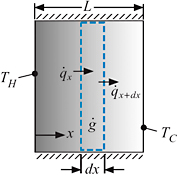
The problem is assumed to be 1-D in the x-direction and therefore an appropriate differential control volume has width dx (see Figure 1-7). Notice the additional energy term in the control volume that is related to the generation of thermal energy. A steadystate energy balance includes conduction into the left-side of the control volume (  x, at position x), generation within the control volume ( ?), and conduction out of the rightside of the control voume (
  , at position x + dx):

or, after expanding the right side:

The rate of thermal...