Heat Transfer
Offering complex and timely real-world problems that are inherently interesting, this book provides engineers with the capability, tools, and confidence to solve real-world heat transfer problems.
 TABLE OF CONTENTS
 The website associated with this book (www.cambridge.org/nellisandklein) provides many more problems than are included here.
Conduction Heat Transfer
1 1 Section 1.1.2 provides an approximation for the thermal conductivity of a monatomic gas at ideal gas conditions. Test the validity of this approximation by comparing the conductivity estimated using Eq. (1-18) to the value of thermal conductivity for a monotonic ideal gas (e.g., low pressure argon) provided by the internal function in EES. Note that the molecular radius, ?, is provided in EES by the Lennard-Jones potential using the function sigma_LJ.
What are the value and units of the proportionality constant required to make Eq. (1-18) an equality?
Plot the value of the proportionality constant for 300 K argon at pressures between 0.01 and 100 MPa on a semi-log plot with pressure on the log scale. At what pressure does the approximation given in Eq. (1-18) begin to fail?
Steady-State 1-D Conduction without Generation
1 2 Figure P1-2 illustrates a plane wall made of a thin ( th w = 0 .001 m) and conductive ( k = 100 W/m-K) material that separates two fluids. Fluid A is at T A = 100 C and the heat transfer coefficient between the fluid and the wall is h A = 10 W/m 2-K while fluid B is at T B = 0 C with h B = 100 W/m 2-K.
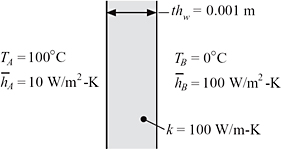
Figure P1-2: Plane wall separating two fluids.
Draw a...