Heat Transfer

Offering complex and timely real-world problems that are inherently interesting, this book provides engineers with the capability, tools, and confidence to solve real-world heat transfer problems.
 TABLE OF CONTENTS
 The constant cross-section fins that were investigated in Section 1.6 are certainly the most common type of extended surface used in practice. However, other extended surface problems (with alternative boundary conditions, more complex thermal loadings, multiple computational domains, etc.) are also encountered. Extended surfaces represent 2-D heat transfer situations that can be approximated as being 1-D and these problems can be solved analytically using the techniques that were introduced in Section 1.6.
An extended surface can be subjected to additional thermal loads such as thermal energy generation (due to ohmic heating, for example) or an external heat flux. These additional effects show up in the governing differential equation but do not affect the character of the solution. Figure 1-46 illustrates an extended surface with cross-sectional area A c and perimeter per that has a uniform volumetric generation (  ) and is exposed to a uniform heat flux (
  , for example from solar radiation). The extended surface is surrounded by fluid at T ? with average heat transfer coefficient h.
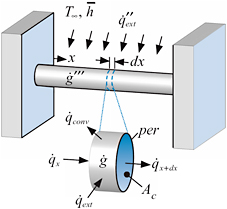
A differential control volume is used to derive the governing differential equation (see Figure 1-46) and provides the energy balance:

The final term can be expanded:

Substituting the appropriate rate equation for each term results in:

where k is the conductivity of the material...