Homogeneous Turbulence Dynamics

Illustrating the main trends using computational and experimental results, this book summarizes the most recent theoretical, computational and experimental results dealing with homogeneous turbulence dynamics.
 TABLE OF CONTENTS
 To caricature, it can be jokingly said that, once one has eliminated all features of a flow that one understands, what remains is turbulence. This sentence, taken from Mathieu and Scott (2000), is even more relevant in HIT, in which no interaction with a structuring effect (mean flow, body force, shock wave, wall, etc.) may occur. HIT, even if it can be described statistically with a few number of quantities, is really the core of the turbulence problem.
Isotropic turbulence can be investigated with both experimental and numerical approaches, despite the fact that it requires the existence of an unbounded domain from the theoretical point of view.
A quasi-isotropic fully developed turbulent state can be reached in wind tunnels with a grid to promote turbulence (see Fig. 3.1). In such a setup, boundary layers develop along solid walls, but an isotropic flow is recovered in the core of wind tunnel. The grid wake transforms a part of mean-flow kinetic energy into turbulent kinetic energy. Downstream of the grid, the mean flow is uniform and no more turbulence-production mechanism takes place. Therefore the turbulent-fluctuation dynamics is entirely governed by the advection that is due to the uniform mean flow, the nonlinear interactions, and the linear viscous effects, leading to a monotonic decay of the turbulent kinetic energy  .
.
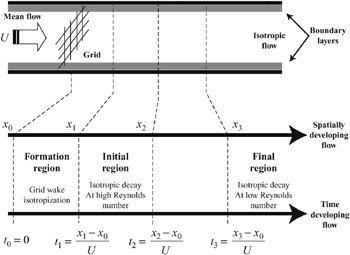
Several regions are usually identified...