Homogeneous Turbulence Dynamics

Illustrating the main trends using computational and experimental results, this book summarizes the most recent theoretical, computational and experimental results dealing with homogeneous turbulence dynamics.
 TABLE OF CONTENTS
 This chapter is devoted to the dynamics of homogeneous turbulent flows submitted to a pure strain. The pure strain case is defined as the case in which the mean-velocity-gradient matrix A is symmetric. As discussed in the rest of this chapter, several experimental setups have been designed during the past few decades that lead to different forms for A. Kinematic aspects, from the design of ducts in experiments to a first insight into RDT (more details are given in Chapter 13), are also introduced in the general case in which A combines a symmetric and an antisymmetric part (mean vorticity) in order to characterize in the simplest way what the specificity is of an irrotational straining process.
Both experiments and numerical simulations lead to the following observations dealing with the dynamics of homogeneous turbulence subjected to pure strain:
The initially isotropic turbulence becomes anisotropic in the presence of a mean strain, and the principal axes of the RST become identical to those of the A, the axis of contraction for A corresponding to the direction of maximum amplification for the RST. If the strain is applied for a long enough time, anisotropy reaches an asymptotic state. Typical results are displayed in Fig. 5.1.
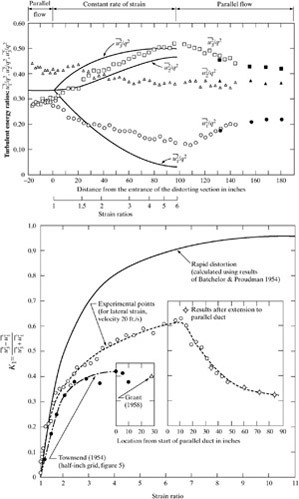
Figure 5.1. Time evolution of anisotropy in the pure strain case with isotropic initial field. Top: evolution of the three components of the total kinetic energy (solid curves: linear RDT prediction; symbols: experiments). Bottom: evolution of the structural anisotropy...