Homogeneous Turbulence Dynamics
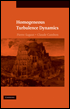
Illustrating the main trends using computational and experimental results, this book summarizes the most recent theoretical, computational and experimental results dealing with homogeneous turbulence dynamics.
 TABLE OF CONTENTS
 This chapter includes detailed equations that are not given in Chapters 4, 5, and 7. Fundamentals of anisotropic triadic closures are given in Chapter 4. A general discussion is offered on various aspects of these closures. Strong anisotropy is the most original aspect that is emphasized throughout this book, but it is perhaps useful to recall the role of the characteristic time (e.g., eddy damping in EDQNM) for the decorrelation of triple correlations in canonical incompressible HIT, and not only in EDQNM. The closure for compressible quasi-isentropic isotropic turbulence, which is a very interesting case of interaction of strong solenoidal turbulence with pseudo-acoustical weak wave turbulence, also merits additional discussion. Finally, the theory of linear response by Kaneda and co-workers, touched on in Chapter 5, is rediscussed in connection with an approach to weak anisotropy.
All technical details about EDQNM for HIT are given in Chapter 3. In this case, and only looking at the power-law slope of the single-time energy spectrum E( k) in the inertial range, all triadic theories, including the most sophisticated self-consistent ones, from DIA to TFM, LHDIA and LRA, can be analyzed from the following simple, purely dimensional and local in wave space, argument [*]:

where ?( k) is the ED term in EDQNM, or a constant external frequency in isotropic or isotropized wave-turbulence theory. A link of the exponent of...