Homogeneous Turbulence Dynamics

Illustrating the main trends using computational and experimental results, this book summarizes the most recent theoretical, computational and experimental results dealing with homogeneous turbulence dynamics.
 TABLE OF CONTENTS
 Isotropy implies that the two-point second-order correlation tensor

(time is omitted for the sake of brevity) can be expressed as R ij = A( r) ? ij + B( r) r i r j, or

introducing the scaling factor  and using the longitudinal correlation function

and its tranverse counterpart

in which n is a unit vector normal to r (see Fig. 3.7).
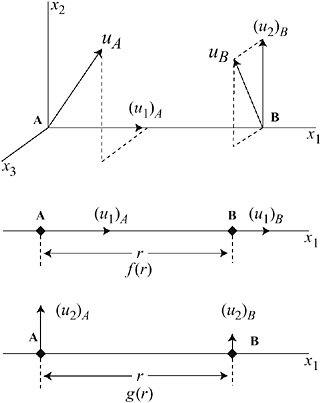
The scalar correlation functions f and g are linked by the incompressibility constraint. Using  one obtains

Finally, reintroducing the time dependency, the evolution equation for the two-point second-order tensor amounts to the single scalar equation, e.g., for f, as follows:

which is referred to as the Karman Howarth equation. The term R LL ,L represents the longitudinal two-point third-order correlation function, which is involved by means of the quadratic nonlinearity. It is defined as

A slightly different form can be found in Mathieu and Scott (2000).
Typical spatial length scales of turbulence can be defined by functions f( r) and g( r). The longitudinal and transverse integral length scales, denoted...