HVAC: The Handbook of Heating, Ventilation and Air Conditioning for Design and Implementation

A basic understanding of all three modes of heat transfer, conduction, convection, and radiation, is important in heating, cooling, and ventilation calculations. At first we introduce the basic definitions of the modes of heat transfer, and then their applications will be discussed.
Conduction. In gases and liquids, heat transfer by conduction can be defined as the net energy transfer due to random molecular motion (diffusion) in the absence of fluid bulk motion. In solids, heat conduction is due to vibrational motion of the molecules in the lattice and the flow of electrons. It should be noted that higher temperature of molecules is associated with higher molecular energy. The conduction heat transfer rate through any medium depends on the following:
geometry of the medium;
thickness of the medium;
type of the medium; and
temperature gradient across the medium.
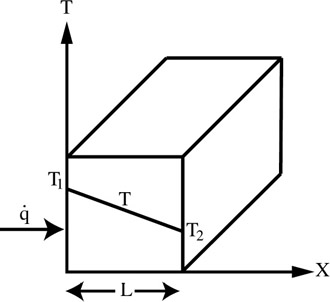
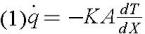
The conduction heat transfer rate can be quantified in the one-dimensional plane (Fig. 5-1) as
where q is the rate of heat transfer, Btu/hr in the X direction, and K (Btu/ hr-ft- R) is the thermal conductivity of the medium. Equation (1) is also called Fourier's law of heat conduction. The minus sign indicates heat transfer in the direction of decreasing temperature.
Thermal conductivity is a property of the substance and a function of temperature. The values of thermal conductivity of some materials at room temperature are given in Table 5-1, and the range of thermal conductivity of various materials...