HVAC: The Handbook of Heating, Ventilation and Air Conditioning for Design and Implementation

Hot water heating systems (hydronic heating) are conveniently being used in many types of buildings and facilities, especially for single family houses and low rise multiple dwelling buildings. Also many HVAC systems are using hot water systems as the primary source for heating the distribution air. The chilled water cooling systems (hydronic cooling) are popular in certain large residential buildings, hospitals, and office buildings. The main components of a hydronic system are:
boiler (heating source) or chiller (cooling source)
circulating pump(s)
expansion tank(s)
Heating load (radiators, convectors, HVAC units, etc.) or Cooling load (terminal units, fan-coil units, HVAC units, etc.)
air separator
connected piping system
make-up and fill water system
control system.
The hydronic system can be classified by combination of:
1) operating temperature; 2) pumping and piping arrangement; and 3) operating pressure.
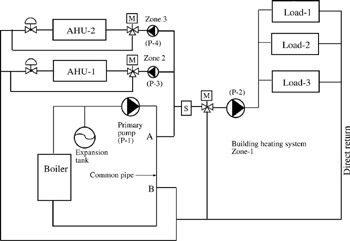
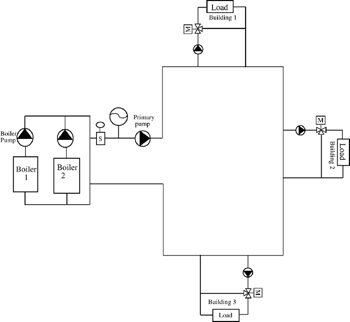
Depending on the particular application and the type of the facility, the proper selection of the boiler(s) or chiller(s), pumping systems, piping arrangement, and control system are essential for an effective and economical hydronic system. Schematic piping drawings of some heating and cooling systems are given in Figs. 10-1 to 10-5.