Hydraulic Design Handbook

Chapter 5: Environmental Hydraulics

Overview

Richard H. French

Water Resources Center

Desert Research Institute

University and Community College System of Nevada

Reno, Nevada

Steven C. McCutcheon

Ecosystems Research Division

National Exposure Research Laboratory

U.S. Environmental Protection Agency

Athens, Georgia

James L. Martin

AScI Corporation

Athens, Georgia

5.1 INTRODUCTION

The thermal, chemical, and biologic quality of water in rivers, lakes, reservoirs, and near coastal areas is inseparable from a consideration of hydraulic engineering principles; therefore, the term environmental hydraulics. In this chapter we discuss the basic principles of water and thermal budgets as well as mixing and dispersion.

5.2 WATER AND THERMAL BUDGETS

5.2.1 Water Budget

A water budget is a statement of the law of conservation of mass or

(5.1)

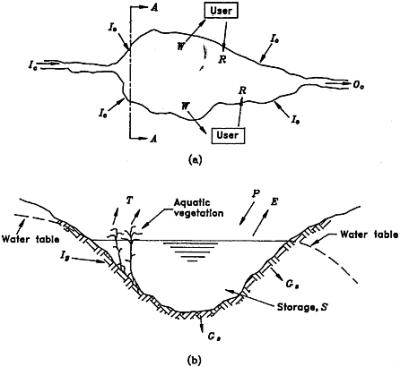
and the expressions of the water budget can range from simple to very complex. For example, consider the lake or reservoir shown in Figure 5.1. For this situation, a generic water budget could be written as follows:


Figure 5.1: A hypothetical lake illustrating the variables in the water budget.
(5.2)

where I c = channel inflow rate, I o = overland inflow rate, I g = groundwater inflow rate, P r = precipitation rate, R r = return flow rate, E v = evaporation rate, T r = transpiration rate, G s = groundwater seepage rate, O c = channel outflow rate, W = consumptive withdrawal, and S s = lake/reservoir storage rate at time t (volume).

The solution of...

UNLIMITED FREE
ACCESS
TO THE WORLD'S BEST IDEAS

SUBMIT
Already a GlobalSpec user? Log in.

This is embarrasing...

An error occurred while processing the form. Please try again in a few minutes.

Customize Your GlobalSpec Experience

Category: Pond and Lagoon Aerators
Finish!
Privacy Policy

This is embarrasing...

An error occurred while processing the form. Please try again in a few minutes.