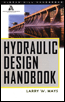
Hydraulic Design Handbook

Chapter 17: Hydraulic Design of Spillways

H. Wayne Coleman

C. Y. Wei

James E. Lindell

Harza Engineering Company
Chicago, Illinois

17.1 INTRODUCTION

The spillway is among the most important structures of a dam project. It provides the project with the ability to release excess or flood water in a controlled or uncontrolled manner to ensure the safety of the project. It is of paramount importance for the spillway facilities to be designed with sufficient capacity to avoid overtopping of the dam, especially when an earthfill or rockfill type of dam is selected for the project. In cases where safety of the inhabitants downstream is a key consideration during development of the project, the spillway should be designed to accommodate the probable maximum flood. Many types of spillways can be considered with respect to cost, topographic conditions, dam height, foundation geology, and hydrology. The spillways discussed in this chapter include overflow, overfall, side-channel, orifice, morning-glory, labyrinth, siphon, tunnel, and chute spillways A section on design of spillways that considers cavitation and aeration also is included.

17.2 OVERFLOW SPILLWAY

An overflow spillway can be gated or ungated, and it normally provides for flow over a gravity dam section. The flow remains in contact with the spillways surface (except for possible aeration ramps) from the crest of the dam to the vicinity of its base. The hydraulic characteristics are defined as follows:

  1. Determine design head H o. Normally, H o is 75 to 80% of maximum head H max.

  2. Use the depth from...

UNLIMITED FREE
ACCESS
TO THE WORLD'S BEST IDEAS

SUBMIT
Already a GlobalSpec user? Log in.

This is embarrasing...

An error occurred while processing the form. Please try again in a few minutes.

Customize Your GlobalSpec Experience

Category: Precast Concrete Products
Finish!
Privacy Policy

This is embarrasing...

An error occurred while processing the form. Please try again in a few minutes.