Hydraulic Design Handbook

14.3: FLOW IN A SEWER

14.3 FLOW IN A SEWER

14.3.1 Flow in a Single Sewer

Open-channel flow in sewers and other drainage conduits are usually unsteady, nonuniform, and turbulent. Subcritical flows occur more often than supercritical. For slowly time varying flow such as the case of the flow traveling time through the entire length of the sewer much smaller than the rising time of the flow hydrograph, the flow can often be treated approximately as stepwise steady without significant error.

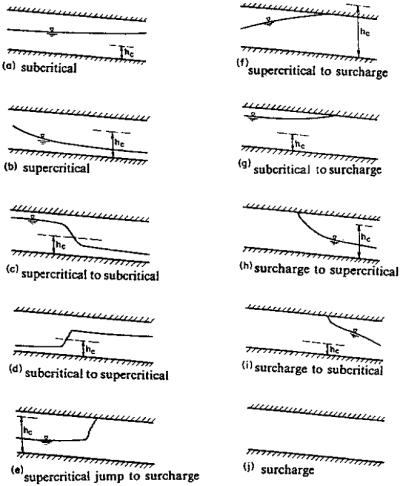
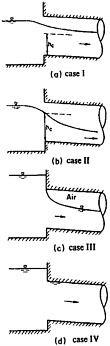
The flow in a sewer can be divided into three regions: the entrance, the pipe flow, and the exit. Figure 14.7 shows a classification of 10 different cases of nonuniform pipe flow based on whether the flow at a given instant is subcritical, supercritical, or surcharge. There are four cases of pipe entrance condition, as shown in Fig. 14.8 and below:


Figure 14.7: Classification of flow in a sewer pipe. (After Yen, 1986a).

Figure 14.8: Types of sewer entrance flow. (After Yen, 1986a).

Case

Pipe entrance hydraulic condition

I

Nonsubmerged entrance, subcritical flow

II

Nonsubmerged entrance, supercritical flow

III

Submerged entrance, air pocket

IV

Submerged entrance, water pocket

Case I is associated with downstream control of the pipe flow. Case II is associated with upstream control. In Case III, the pipe flow under the air pocket may be subcritical, supercritical, or transitional. In Case IV, the sewer flow is often controlled by both the upstream and downstream conditions.

Pipe exit conditions also can be grouped into four cases as shown in...

UNLIMITED FREE
ACCESS
TO THE WORLD'S BEST IDEAS

SUBMIT
Already a GlobalSpec user? Log in.

This is embarrasing...

An error occurred while processing the form. Please try again in a few minutes.

Customize Your GlobalSpec Experience

Category: Vortex Flow Meters
Finish!
Privacy Policy

This is embarrasing...

An error occurred while processing the form. Please try again in a few minutes.