Interpreting Organic Spectra

Chapter 2: Mass Spectrometry

Overview

Mass spectrometry gives us some information about the structure of a molecule. It can usually tell us the molecular weight of a substance, and can detect the presence of bromine, chlorine and iodine. It may be possible to deduce the structure of a compound from its mass spectrum.

Unlike the other techniques studied in this book, it is a spectrometric, not a spectroscopic, method. It does not involve the absorption of radiation; it consists of generating ions of such energy that they fragment, collecting fragments of the same mass together, and weighing them. Some fragments are more stable than others, and so are produced to a much greater extend than others, and we see large peaks in the spectrum at their mass. Using knowledge of favoured fragmentations, a surprising amount of information about the structure of the original molecule can be obtained.

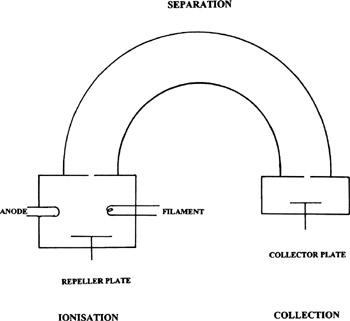
Mass spectrometers operate at very low pressures, so that the ions can travel long distances without undergoing collisions. The mass spectrometer consists basically of three parts, as shown schematically in Diagram 2.1. The regions of the spectrometer can be described according to their function, as ionisation, separation and collection.


Diagram 2.1

Ionisation

The material to be studied is introduced into the ionisation chamber in the vapour phase. It is bombarded with a stream of electrons, generated by the filament and accelerated to about 70 eV by the anode.

If an electron at this energy hits one of the atoms being studied, the atom gains considerable vibrational energy,...

UNLIMITED FREE
ACCESS
TO THE WORLD'S BEST IDEAS

SUBMIT
Already a GlobalSpec user? Log in.

This is embarrasing...

An error occurred while processing the form. Please try again in a few minutes.

Customize Your GlobalSpec Experience

Category: Mass Spectrometers
Finish!
Privacy Policy

This is embarrasing...

An error occurred while processing the form. Please try again in a few minutes.