Interpreting Organic Spectra

Chapter 4: Ultraviolet Spectroscopy

Overview

Ultraviolet spectroscopy tells us about conjugation in a molecule. It uses the highest energy radiation of any of the techniques described in this book; radiation at 200 nanometres is equivalent to 595 kilojoules per mole. Absorption of this energy raises an electron from a bonding orbital to an antibonding orbital.

Almost all ultraviolet spectroscopy involves radiation from 200 nm to 400 nm (1 nm = 10 ?7cm = 10 = 1 m ?). The region is often extended from 400 to 800 nm to cover the visible spectrum. The region below 200 nm, often referred to as the far ultraviolet, requires special equipment, since oxygen absorbs just below 200 nm.

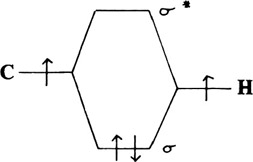
The ultraviolet spectrum measures the energy absorbed by an electron making the transition from a bonding to an antibonding orbital. If we look at a very simple, molecule, methane, CH 4, then we see that it contains only C-H bonds. Since it is symmetrical, all the C-H bonds are equivalent, and we need to consider only one bond. If we take a carbon atom and a hydrogen atom, and consider a single electron attached to each, as shown in Diagram 4.1, we have the energy levels shown. If we then bring these atoms together, and use the electrons to form a bond, then two orbitals are formed, these having differing energy levels.


Diagram 4.1: Orbital changes when a C atom and an H atom form a C H bond

The bonding electrons occupy the lower...

UNLIMITED FREE
ACCESS
TO THE WORLD'S BEST IDEAS

SUBMIT
Already a GlobalSpec user? Log in.

This is embarrasing...

An error occurred while processing the form. Please try again in a few minutes.

Customize Your GlobalSpec Experience

Category: UV Light Systems
Finish!
Privacy Policy

This is embarrasing...

An error occurred while processing the form. Please try again in a few minutes.