Interpreting Organic Spectra

We have now seen how to identify functional groups by infrared spectroscopy and to find the molecular weight, halogen content and structural features of a molecule by mass spectrometry. If we use both techniques on a sample, then we can substantially extend the range of molecules we can identify. Both infrared spectroscopy and mass spectrometry can identify almost any molecule by comparison with a spectrum of the authentic material, but when working entirely with unknowns it is often difficult to distinguish isomers. The substances whose spectra you are given are generally simple ones, where isomerism is not a problem, so you should be able to identify each sample from its spectra.
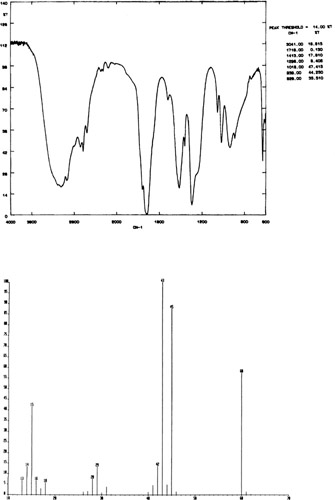
| 1. | Sample 3.1 |
|
| 2. | Sample 3.2 |
|
| 3. | Sample 3.3 |
|
| 4. | Sample 3.4 |
|
| 5. | Sample 3.5 |
|
| 6. | Sample 3.6 |
|
| 7. | Sample 3.7 |
|
| 8. | Sample 3.8 |
|
| 9. | Sample 3.9 |
|
| 10. | Sample 3.10 |
|
Answers
| 1. | Propan-2-one (acetone) |
| 2. | Ethanol |
| 3. | 2-Bromoethanol |
| 4. | Acetonitrile |
| 5. | Benzaldehyde |
| 6. | Ethanoic acid anhydride (acetic anhydride) |
| 7. | Ethanoic acid (acetic acid) |
| 8. | Methyl acetate |
| 9. | Chloroacetonitrile |
| 10. | Pentan-3-one |