Introduction to 802.16 WiMax, Wireless Broadband Technology, Market, Operation and Services
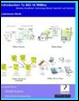
Worldwide Interoperability for Microwave Access (WiMax) is a wireless communication system that allows computers and workstations to connect to high-speed data networks (such as the Internet) using radio waves as the transmission medium with data transmission rates that can exceed 120 Mbps for each radio channel [1]. The WiMax system is defined in a group of IEEE 802.16 industry standards and its various revisions are used for particular forms of fixed and mobile broadband wireless access.
WiMax is system that is primarily used as a wireless metropolitan area network (WMAN). WMANs can provide broadband data communication access throughout an urban or city geographic area. WMANs are used throughout the world and their applications include consumer broadband wireless Internet services, interconnecting lines (leased lines) and transport of digital television (IPTV) services. WiMax broadband wireless can compete with DSL, cable modem and optical broadband connections.
The 802.16 system was designed for fixed location Nomadic service. Nomadic service is the providing of communication services to more than one location. While nomadic service may be provided too many locations, nomadic service typically requires the transportable communication device to be fixed in location during the usage of communication service.
For mobile service, the 802.16e was developed. The 802.16 specification adds mobility management, extensible authentication protocol (EAP), handoff (call transfer), and power saving sleep modes.
WiMax has several different physical radio transmission options which allow WiMax systems to be deployed in areas with different regulatory and frequency availability requirements. The WiMax system was designed...