Introduction to 802.16 WiMax, Wireless Broadband Technology, Market, Operation and Services
Wide-area wireless broadband systems are typically composed of end user subscriber stations (access devices), base stations (access nodes), packet switches and gateways.
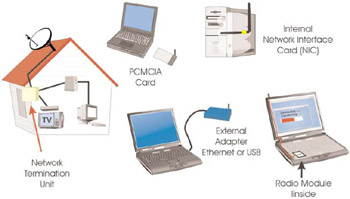
Subscriber stations (SS) in a WiMax system are transceivers (transmitter and receivers) that convert radio signals into digital signals that can be routed to and from communication devices. The types of WiMax subscriber stations range from portable PCMCIA cards to fixed stations that provide service to multiple users.
Subscriber stations may be capable of full frequency division duplex (FDD), half frequency duplex (H-FDD), time division duplex (TDD) or any combination of these access types.
Figure 1.42 shows the different types of WiMax access devices. This diagram shows that WiMax access devices include external boxes that connect to an Ethernet or USB port, PCMCIA card with external antennas or portable devices with built in radio modems.
A base station is a radio access transceiver (combined transmitter and receiver) that is used to connect subscriber stations to WiMax system. Base stations convert and control the sending of data packets and can connect one or many wireless devices to a backbone network.
Base stations can perform one or many types of data transfer functions including bridging (linking networks), retransmitting (repeating), distributing (hubs), directing packets (switching or routing) or to adapt formats for other types of networks (gateways).
A packet switch is a device in a data transmission network that receives and forwards packets of data. The packet switch receives...