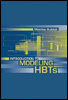
Introduction to Modeling HBTs

Chapter 1: Introduction

1.1 HETEROJUNCTION BIPOLAR TRANSISTORS

Using a material with a wider bandgap for the emitter adds a degree of freedom in the design of bipolar transistors, which enables operation at high power densities and high frequencies at the same time. Invented and patented in the 1950s by W. Shockley [1] and extensively theoretically investigated by H. Kroemer in the 1970s [2], the technology did not become available until the 1980s. A tremendous development has taken place since then and the heterojunction bipolar transistor (HBT) has become an indispensable microwave device. At the time of this writing, three types of HBT technology are commercially available:

  • Si/SiGe HBTs, where germanium is introduced into the base of a silicon bipolar transistor either to create a heterojunction at the emitter, or in order to induce a field gradient that accelerates the electrons in the base. These devices are mostly available together with standard CMOS technologies, so-called BiCMOS, which enables the integration of RF and digital circuits.

  • GaAs-based HBTs. The main application for these devices are power amplifiers for cellular phones. However, the high cutoff frequencies enable many other applications, too, such as components for wireless businesses, which require high breakdown voltages at moderately high frequencies.

  • InP-based HBTs provide the highest power handling capabilities at the highest frequencies compared to the other technologies. Hence, the main application of these devices are driver amplifiers for multigigabit optical transmission systems. These devices often are DHBTs, which employ a high bandgap material in the collector also to enhance the...

UNLIMITED FREE
ACCESS
TO THE WORLD'S BEST IDEAS

SUBMIT
Already a GlobalSpec user? Log in.

This is embarrasing...

An error occurred while processing the form. Please try again in a few minutes.

Customize Your GlobalSpec Experience

Category: Darlington Transistors
Finish!
Privacy Policy

This is embarrasing...

An error occurred while processing the form. Please try again in a few minutes.