Introduction to Satellite Communication, Third Edition
The satellite communication industry has grown tremendously since the first edition of this text, and with it the number of professionals and the range of activities have grown as well. With many of the originators of the basic technical and operating principles having reached retirement, it is likely that a significant fraction of industry participants lack a historical perspective. What follows is an overview of key developments and events; it is not meant to be exhaustive. It can only be said that satellite communication is an extremely rich field of endeavor, encompassing space technology, telecommunications systems, information technology, entertainment television and audio, and the Internet. Add to that the introduction of new markets in satellite-based mobile communication, and you begin to comprehend the possibilities for new historical chapters.
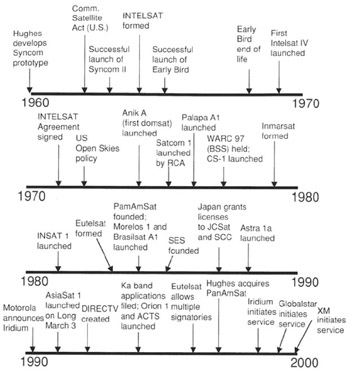
Figure 2.1 is a basic timeline of many of the critical events. A familiarity with the past satellite programs and applications will aid the reader in understanding why today's satellite systems and services are the way they are. This chapter can be read in sequence or deferred until the basic concepts covered in Chapters 3 through 8 have been absorbed. Additional historical background can be found in [1].
While various individuals in the early part of this century recognized the existence of the 24-hour geostationary orbit, it is the late science fiction author Arthur C. Clarke who is credited with conceiving of the application...