Introduction to Satellite Communication, Third Edition
Digital communication formats and transmission systems have long been used over commercial satellites. To understand how a satellite link actually transfers information between Earth stations, we must delve into the twin topics of modulation and multiple access. We will quickly see that these relate directly to the analog or digital format being applied. Also important are the impairments to digital transmission produced by nonlinearity and nonideal frequency response of the end-to-end link.
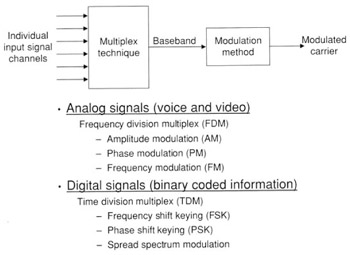
The discussion that follows is reasonably technical and detailed, but the topics of modulation and multiple access are extremely important to the cost-effective use of communications satellites. In most networks, the efficiency of transmission is increased by combining several channels of information with a process called multiplexing, creating a baseband spectrum in electrical form. Modulation is the process by which the baseband is then impressed on a carrier. The arrangement and the sequence of these functions for analog and digital formats are shown in Figure 5.1. In Chapter 4, we touched on the role of modulation in transmitting user information with adequate circuit quality on a microwave link. The type of modulation as well as the specific parameters employed also determine how much traffic the satellite repeater can carry in aggregate. Also, the types of connectivity and flexibility achieved in serving multiple earth stations depend to some degree on the modulation system. Those aspects of RF transmission and link connectivity are referred to as multiple access.