Introduction to Satellite Communication, Third Edition

9.6: Earth Station Facility Design

9.6 Earth Station Facility Design

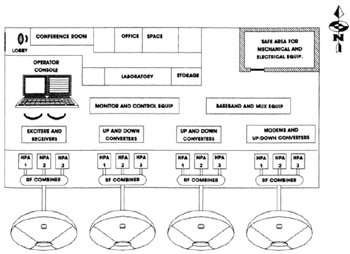
The last practical consideration to be covered is the physical installation of the Earth station, that is, the design of the building and the arrangement of equipment therein. It is instructive to take as an example the layout of the site and building for a major Earth station, shown in Figure 9.17. Many of the same principles can be applied to smaller stations, including VSATs. The drawing assumes operation with GEO satellites with the station located north of the equator. Consequently, the antennas are aligned along the southern perimeter of the site to afford good visibility of the orbit arc. This arrangement of the antennas is usually the most flexible if there is sufficient space between the reflectors to allow independent pointing of each main beam to any orbit position. Care in placing the foundations must be taken so that antennas never touch each other during repointing and that the beams do not overlap one another to a significant degree. The latter minimizes the interaction of the electromagnetic fields around the antennas, including the effects of diffraction. With proper isolation between antennas, the beams will be properly formed, giving the desired cross-polarization isolation and contol of sidelobes.


Figure 9.17: Site plan and equipment arrangement for a typical major Earth station.

The next important aspect is the location and arrangement of the RF equipment. The LNAs or LNBs should be mounted directly on the receive port of the feedhorn to minimize noise and loss. That also...

UNLIMITED FREE
ACCESS
TO THE WORLD'S BEST IDEAS

SUBMIT
Already a GlobalSpec user? Log in.

This is embarrasing...

An error occurred while processing the form. Please try again in a few minutes.

Customize Your GlobalSpec Experience

Category: Antennas
Finish!
Privacy Policy

This is embarrasing...

An error occurred while processing the form. Please try again in a few minutes.