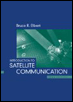
Introduction to Satellite Communication, Third Edition
Chapter 4: Microwave Link Engineering

Overview

Microwave link engineering is the branch of communication engineering that deals with the analysis, design, implementation, and testing of radio paths in the atmosphere or in space, operating in the range of about 1 to 100 GHz. Satellite and other microwave radio links obey certain rather predictable laws of nature, allowing engineers to design satellite networks on paper (or, more likely, on computer) with good accuracy. An unobstructed line-of-sight path provides the most predictable transmission link; however, various forms of signal absorption (attenuation), blockage, and multipath propagation (caused by reflections) introduce time-varying fading, which can best be estimated using statistical techniques. Nevertheless, the service obtained from microwave links between the satellites and ground stations can be very acceptable, even when compared to terrestrial cable and radio (wireless) systems.

This chapter is intended for engineers and scientists new to the field and is perhaps the most mathematical chapter in the book. Nontechnical readers may wish to scan it rather than delve into the details. In general, microwave energy travels in straight lines through space in the same manner as a light beam. That should not be a surprise because both light and microwaves are forms of electromagnetic energy, light being at much higher frequencies or, equivalently, shorter wavelengths. Radio waves in general and microwaves in particular can propagate through space like light and heat, spreading out as they move farther and farther from the source. The waves travel through a vacuum at the universal speed of light, the same for...

UNLIMITED FREE
ACCESS
TO THE WORLD'S BEST IDEAS

SUBMIT
Already a GlobalSpec user? Log in.

This is embarrasing...

An error occurred while processing the form. Please try again in a few minutes.

Customize Your GlobalSpec Experience

Category: UV Light Systems
Finish!
Privacy Policy

This is embarrasing...

An error occurred while processing the form. Please try again in a few minutes.