Introduction to the Dimensional Stability of Composite Materials

This comprehensive text brings together the best quantitative methods and currently known data for understanding how composites become unstable over time.
 TABLE OF CONTENTS
 Macromechanics is the study of composite material behavior wherein the material is presumed to be homogeneous, and the effects of the constituent materials are detected only as averaged apparent macroscopic properties of the composite materials [13]. We employ micromechanics to determine the properties of individual layers (laminae or plies) and then use only these layer properties to describe the (macroscopic) composite. These models apply to products such as laminated carbon fiber reinforced plastics (CFRP), panels with composite facesheets and honeycomb or foam cores, thin-walled tubes, plywood, and laminated wood products,
The extension of the generalized Hooke's law to simplified relations based on specific stress states and material symmetry was introduced in Section 3.2. In addition, the concept of layers and their notation was discussed. With laminated composite materials, one typically considers a two-dimensional stress state, where the stresses ? 3 = ? 23 = ? 13 = 0; ? referring to the shear stresses. For a material with three axes of symmetry (generally orthotropic) in a state of plane stress (the 1-2 axis system), and using standard engineering notation, Equation 3.5 reduces to:
| (3.26) |  |
The compliances are defined in terms of the basic properties of the layers as determined from micromechanics considerations. Thus
| (3.27) | 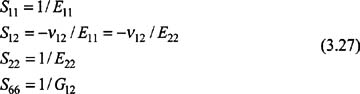 |
Equation 3.26 assumes that the axes of symmetry are arbitrary. If we reference the axes of symmetry such that the fiber direction is the 1-axis, we have the "specially" orthotropic case and S 16 = S 26