Introduction to the Dimensional Stability of Composite Materials

This comprehensive text brings together the best quantitative methods and currently known data for understanding how composites become unstable over time.
 TABLE OF CONTENTS
 The concept of curvature, or out-of-plane warping, is an important feature any discussion of dimensional stability. It was introduced in Section 3.4 via Equations 3.31, 3.32 and 3.33 to develop the total plate constitutive Equations 3.41 and 3.42. This section gives some general relations for plate curvature based on laminate theory. If we first consider a single, isotropic layer, it is shown [12] that:
| (3.52) | 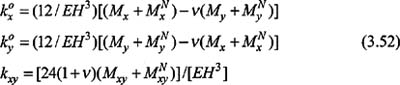 |
where E is the extensional Young's modulus, H the total layer thickness and ? is the Poisson's ratio of the single layer of material. For laminates, we note from Equation 3.46 that:
| (3.53) |  |
For symmetric and/or balanced laminates the [ b] terms are zero. With symmetric cross-ply laminates:
| (3.54) | 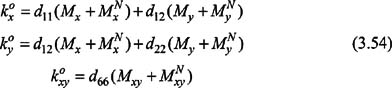 |
Where
| (3.55) | 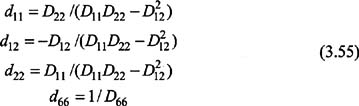 |
For unsymmetrical, unbalanced layups, one needs to work with the full matrix given in Equation 3.46. In general, whenever the [ B] terms are all zero, a non-mechanical load causes no curvature. Thus, for a flat laminate, the layup should be symmetrical about the midplane. Anti-symmetric layups have zero [ B] terms except for B 16 and B 26, and this generally leads to a twist on hygrothermal loads. A curved panel would also be subject to this twist. A class of layups reported by Winkler [47] is an exception. Even though the B matrix terms are non-zero, one can still find an absence of out-of-plane curvature on hygrothermal loading. The HTCC stands for "Hydrothermally Curvature Stable Coupling," an example of which is: