Introduction to WCDMA: Physical Channels, Logical Channels, Network, and Operation

Use this concise guide to learn the fundamental components, basic operation, services, and terminology used for UMTS code division multiple access (CDMA) systems.
 TABLE OF CONTENTS
 Channels are a portion of a physical communications channel that is used to for a particular communications purpose. There are two groups of channels used in the WCDMA system; control channels and traffic channels. Control channels are used to setup, manage, and terminate communication sessions. Traffic channels are primarily used to transfer user data but can also transfer some control information. Some of the channels on the WCDMA system use separate coding so they can be simultaneously transmitted and decoded by the receiver and other channels are logical channels that share a coded channel.
Channel structure is the division and coordination of a communication channel (information transfer) into logical channels, frames (groups) of data, and fields within the frames that hold specific types of information. The WCDMA system has different channel structures for the forward and reverse directions.
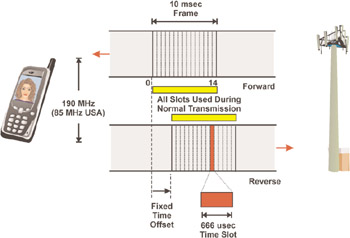
Figure 1.17 shows the channel structure and duplex channel spacing for the WCDMA system. This diagram shows that each coded communication channel (traffic channel) is divided into 10 msec frames an that each of the frames is divided into 666 usec time slots. All the time slots are used during normal transmission. This example also shows that the duplex channel spacing between the uplink and the downlink is nominally 190 MHz (85 MHz for USA). The 10 msec frames for the forward and reverse channels is transmitted with a fixed time offset relative to each other.