ISA Handbook of Measurement Equations and Tables, 2nd Edition

1 psi = 6.895 kPa
1 kPa = 0.1450 psi
1 bar = 100 kPa
1 bar = 14.50 psi
1 MPa = 145.0 psi
1 psi = 27.73 inches of water at F or C
1 psi = 2.310 feet of water at F or C
1 kPa = 7.5 mm of water at F or C
1 kPa = 4.019 inches of water at F or C
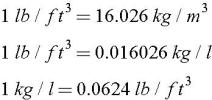
1 lb/ft 3 = 16.026 kg/m 3
1 lb/ft 3 = 0.016026 kg/liter
1 kg/l = 0.0624 lb/ft 3
1 lb/ft-sec = 0.000672 centipoise
Absolute pressure is the actual pressure of the fluid with respect to a perfect vacuum, regardless of the atmospheric pressure on the outside of the container.
Gauge pressure is the fluid pressure with respect to the atmospheric pressure outside its container.
Differential pressure is the difference between two pressures. Note that gauge pressure is actually a differential pressure between fluid pressure and atmospheric pressure.
Density is defined as the mass of the fluid per unit volume ( p = m/V). In the English system, density is typically expressed in pounds per cubic foot, where the pounds represent mass rather than force. In the metric system, density is typically expressed in kilograms per cubic meter or kilograms per liter. Equivalence formulas are:
Temperature changes have a significant effect on liquid densities. The effect of pressure is normally so small it can be...