ISA Handbook of Measurement Equations and Tables, 2nd Edition

Viscosity is a quantity describing a fluid's resistance to flow. Fluids resist the relative motion of immersed objects through them as well as to the motion of layers with differing velocities within them.
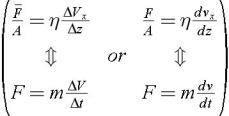
Formally, viscosity (represented by the symbol ?) is the ratio of the shearing stress (F/A) to the velocity gradient ( ?v x/ ?z or dv x/ dz) in a fluid.
The more usual form of this relationship is called "Newton's equation." It states the resulting shear of a fluid is directly proportional to the force applied and inversely proportional to its viscosity. Note the similarity to Newton's second law of motion (F=ma).
According to NIST's Guide for the International System of Units (SI), the proper SI units for expressing values of viscosity ? (also called dynamic viscosity) and values of kinematic viscosity v are, respectively, the Pascal second (Pa s) and the meter squared per second (m 2/s) (and their decimal multiples and submultiples as appropriate).
The Pascal second [Pa s] has no special name. And, although touted as an international system, the International System of Units (SI) has had very little international impact. The Pascal second is rarely used in scientific and technical publications today.
The most common unit of viscosity is the dyne second per square centimeter (dyne s/cm 2), which is given the name poise (P) after the French physiologist Jean Louis Poiseuille (1799-1869). Ten poise...