Lectures on Modern Convex Optimization: Analysis, Algorithms, and Engineering Applications

In this chapter our primary goal is to present the basic results on the linear programming (LP) duality in a form that makes it easy to extend these results to the nonlinear case.
An LP program is an optimization program of the form
where
x ? R n is the design vector,
c ? R n is a given vector of coefficients of the objective function c T x,
A is a given m n constraint matrix, and
b ? R m is a given right-hand side of the constraints.
(LP) is called
feasible if its feasible set
is nonempty; a point
is called a feasible solution to (LP);
bounded below if it is infeasible or if its objective c Tx is bounded below on
.
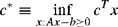
For a feasible bounded-below problem (LP), the quantity
is called the optimal value of the problem. For an infeasible problem, we set c * = + ?, while for a feasible unbounded-below problem we set c * = ? ?.
Linear programming is called solvable if it is feasible and bounded below and the optimal value is attained, i.e., there exists
with c T x = c *. An x of this type is called an optimal solution to LP.
A priori it is unclear whether a feasible and...