Lectures on Modern Convex Optimization: Analysis, Algorithms, and Engineering Applications

Structural design is an engineering area dealing with mechanical constructions like trusses and plates. We already know what a truss is-a construction made up of thin elastic bars linked to each other. A plate is a construction made up of a material occupying a given domain, the mechanical properties of the material varying continuously from point to point. In engineering, design of plates is called shape design; in what follows we call these objects of our interest shapes instead of plates.
A typical structural design problem is, "Given the type of material to be used, a resource (an upper bound on the amount of material to be used) and a set of loading scenarios-external loads operating on the construction-find an optimal truss or shape, one able to withstand best of all the loads in question." It turns out that numerous problems of this type can be cast as semidefinite programs, which offers a natural way to model and process them analytically and numerically. The purpose of this section is to develop a unified semidefinite-programming-based approach to these structural design problems.
The mechanical constructions we are considering (the so-called constructions with linear elasticity) can be described as follows.
I. A construction C can be characterized by
| 1.1 | A linear space V = R m of virtual displacements of C. |
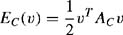
| 1.2 | A positive semidefinite quadratic form |
on the space of displacements. The value of this form at a displacement