Lectures on Modern Convex Optimization: Analysis, Algorithms, and Engineering Applications

4.2: What can be expressed via linear matrix inequalities?

4.2 What can be expressed via linear matrix inequalities?

As in the previous lecture, the first thing to realize when speaking about the SDP universe is how to recognize that a convex optimization program


can be cast as a semidefinite program. Just as in the previous lecture, this question actually asks whether a given convex set or function is semidefinite representable (SDr). The definition of the latter notion is completely similar to the one of a CQr set or function:

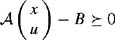
We say that a convex set X ? R n is SDr if there exists an affine mapping ( x, u) ? ? B: R n x R k u ? S m such that


in other words, is SDr if there exists LMI


in the original design vector and a vector u of additional design variables such that is a projection of the solution set of the LMI onto the x-space. An LMI with this property is called semidefinite representation (SDR) of the set X.

A convex function f: R n ? R ? {+ ?} is called SDr if its epigraph


is an SDr set. An SDR of the epigraph of f is called an SDR of f.

By exactly the same reasons as in the case of conic quadratic problems, one has the following:

  1. If f is an SDr function, then all its level sets { x/ f( x) ? a

UNLIMITED FREE
ACCESS
TO THE WORLD'S BEST IDEAS

SUBMIT
Already a GlobalSpec user? Log in.

This is embarrasing...

An error occurred while processing the form. Please try again in a few minutes.

Customize Your GlobalSpec Experience

Category: Boring Tools
Finish!
Privacy Policy

This is embarrasing...

An error occurred while processing the form. Please try again in a few minutes.