Maintenance of Instruments & Systems, 2nd Edition

Maintenance engineers and technicians now live in a more complicated world than that of their predecessors. When control systems first began with simple field controls, both operators and maintenance personnel were close to the process. They could smell it, see it, touch it, and sometimes taste it. They could feel rumblings from the process as pressures or temperatures were changed. A oneness with the system was felt by all those who were related to its operation and control.
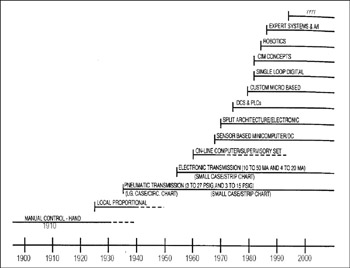
Control began with manual field devices such as hand valves and levers. Gages were used for readout of the process changes. This evolved into field local automatic controls, followed by remote automatic controls in central control rooms. Figure 7-1 provides a historical overview of process control as applied to the pulp and paper industry. Other industries such as chemicals and petrochemicals were more advanced in the application of control systems; the result would be a shift of this curve to the left in some cases.
Each technology advancement has moved operators and maintenance people farther away from the process pulse. Direct use of four of the five human senses has become almost obsolete. It became necessary instead to become accustomed to the pulse of panel instruments that represented the process health and performance.
Each process variable (flow, pressure, temperature, density, pH, conductivity, consistency, etc.) had a discrete place on the panel somewhere. Whether a gage, a recorder pen, or a digital readout...