Maintenance of Instruments & Systems, 2nd Edition

Fiber optics offers many advantages and few disadvantages for use in the process control industry.
Optical fibers can reliably transmit high volumes of data over long distances without repeaters. Their unique combination of immunity, isolation, security, safety and environmental properties makes fiber optics exceptionally well suited for chemical and petroleum industries and other explosive industries. Fiber optic data highways and other communication networks are currently used in the process control and automation industries.
The telephone industry started using fiber optic communications links about 1872 because of its greater information carrying capacity. About 1980, a major instrumentation and control company used fiber optic cable as their data highway for their distributed control systems. Fiber optic switches and sensors are now used in process control applications.
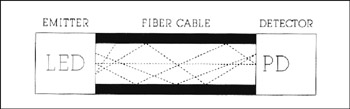
Fiber optic communication is a technology in which light is transmitted along the inside of a thin, flexible glass or plastic fiber (Figure 18-1). An electrical signal is translated into a light signal, usually using light emitting diodes (LEDs) or laser diodes. This is generally called the emitter or source. The light signal may be turned on and off (modulated) at higher frequencies than electrical signals over conventional wires due to the greater bandwidth and lower attenuation. The optical fiber works on the principle of total internal reflection. Once light begins to reflect down the fiber, it will continue to do so. This light signal is received by a photodiode (detector or receiver), which converts the light signal into an electrical signal.