Mechanical Behavior of Materials, Second Edition

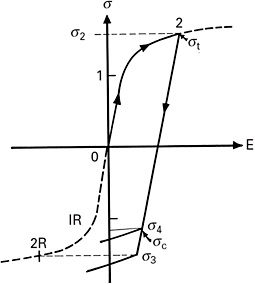
In most materials, plastic deformation in one direction will affect subsequent plastic response in another direction. The translation of the von Mises ellipse (kinematic hardening; see Section 3.7.4) is a manifestation of this relationship. The ellipse will move toward the direction in which the material is stressed. In one-dimensional deformation, the phenomenon is known as the Bauschinger effect. A material that is pulled in tension, for example, shows a reduction in compressive strength. Figure 3.16 illustrates the effect. A stress strain curve is drawn, and the sequence 0 1 2 represents the loading direction. The material is first loaded in tension and yields at 1. At 2, the loading direction is reversed. Unloading occurs along the elastic line until the stresses become compressive. If there were no directionality effect, the material would start flowing plastically at a stress equal to ? 2. The idealized reverse curve is also shown in the figure. If the material did not exhibit a dependence on the stress direction, the compressive curve would be symmetrically opposite to the tensile curve. This idealized curve is drawn in dashed lines. The sequence is 0 1 R 2 R. Thus, compressive plastic flow, after the 0 1 2 tensile sequence, should occur at ? 3 = ? 2 R = ? ? 2. If the material exhibits a Bauschinger effect, this stress is decreased from ? 3 to ? 4. Hence, the material softens upon inversion of the loading direction.