Mechanical Behavior of Materials, Second Edition

3.10: Muscle Force

3.10 Muscle Force

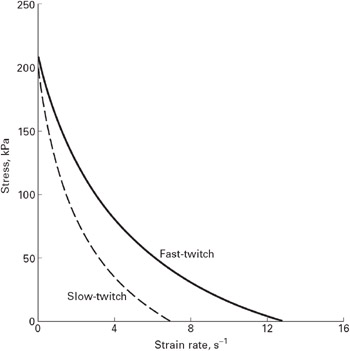
The maximum force that a muscle fiber can generate depends on the velocity at which it is activated. Figure 3.51 shows the stress that can be generated as a function of strain rate for slow-twitch and fast-twitch muscles. We use slow-twitch muscles for long-range events (e.g., distance running) and fast-twitch muscles for explosive activities, such as sprinting or throwing a punch at our professor. Both muscles show a decreasing ability to generate stress as the strain rate is increased. However, the fast-twitch muscles show a lower decay.


Figure 3.51: Stress vs. strain rate for slow-twitch and fast-twitch muscles.

The plot shown in Figure 3.51 is only schematic and represents the rat soleus (slow-twitch) and extensor digitorum longus (fast-twitch). The equation that describes the response in Figure 3.51 is called the Hill [29] equation. It has the form:


where ? 0 is the stress at zero velocity (equal to 200 kPa in Figure 3.51). The range of ? 0 is usually between 100 and 300 kPa; a and b are parameters and is the strain rate (obtained from the velocity).

Example 3.13

A person is lifting a weight by contracting the biceps muscles. Assuming that each muscle fiber has the capacity to lift 300 ?g, and that each muscle fiber has a diameter of 5 ?m, what is the required cross section of biceps muscle needed to lift a mass of 20 kg?

Solution: The cross section...

UNLIMITED FREE
ACCESS
TO THE WORLD'S BEST IDEAS

SUBMIT
Already a GlobalSpec user? Log in.

This is embarrasing...

An error occurred while processing the form. Please try again in a few minutes.

Customize Your GlobalSpec Experience

Category: Strain Gauges
Finish!
Privacy Policy

This is embarrasing...

An error occurred while processing the form. Please try again in a few minutes.