Mechanical Behavior of Materials, Second Edition

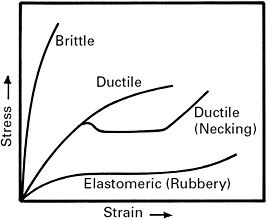
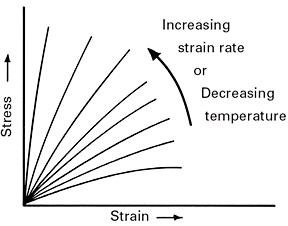
At a microscopic level, deformation in polymers involves stretching and rotating of molecular bonds. More commonly, one distinguishes the deformation mechanisms in polymers as brittle, ductile (with or without necking), and elastomeric. Figure 3.18 shows schematically the curves that correspond to these mechanisms. Clearly, factors such as the strain rate and temperature affect the shape of stress strain curves, much more so in polymers than in ceramics or metals. This is because the polymers are viscoelastic; that is, their stress strain behavior is dependent on time. Temperature and strain rate have opposite effects. Increasing the strain rate (or decreasing the temperature) will lead to higher stress levels, but lower values of strain. Figure 3.19 shows this schematically.
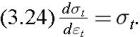
Polymers (especially, linear, semicrystalline polymers), in a manner superficially similar to metals, can show the phenomena of yielding and necking. The necking condition for polymers can be represented, again in a manner similar to that for metals (see Section 3.2.2, Equation 3.19), by:
This equation says that necking occurs when the work-hardening rate d ? t/ d ? t attains a value equal to ?. At that point, the increase in strength due to work-hardening cannot compensate for the loss in strength caused by a decrease in cross-sectional area, and necking ensues.
In a manner similar...