MEMS Mechanical Sensors

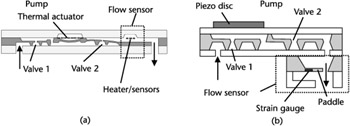
Micromachining has numerous applications in fluidics, and its use in this area has become even more important as people strive to create complete fluidic systems in miniaturized formats. A broad range of devices and systems can be found in the books Microfluidic Technology and Applications [4] and Micromachined Transducers Sourcebook [5], as well as in various review articles published [6 10]. A brief introduction to microfluidics relevant for flow sensors and applications for micro flow sensors is given in this chapter. The first and most obvious microfluidic devices to integrate with a flow sensor were micropumps and/or valves, to form dosing systems or mass flow controllers [11 17]. Schematics of two typical dosing systems are depicted in Figure 9.1.
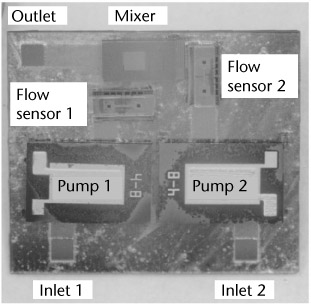
Further integration took place including several pumps, valves, flow sensors, and micromixers to form microanalysis systems ( ?TAS) [18 20]. As an example, a microfluidic system using two pumps, two flow sensors, and a mixer is shown in Figure 9.2 [21]. A microsystem for measurement of flow rate, pressure, temperature, conductivity, UV-absorption, and fluorescence on a single quartz glass chip was presented by Norlin et al. [22]. Another multisensor chip designed for catheter applications has been presented by Goosen et al. [23] and Tanase et al. [24]. It includes blood flow, pressure, and oxygen saturation level sensing.