MEMS Mechanical Sensors

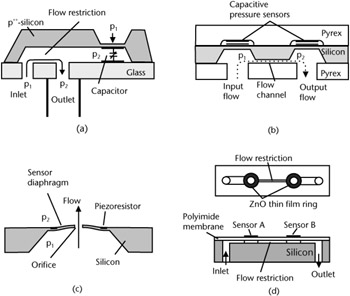
This flow sensing principle relies on the measurement of the differential pressure p in a flowing fluid. Pressure sensors can be used to measure flow by sampling the pressure drop along a flow channel with known fluidic resistance, R f , and calculating the flow Q from the fluidic equivalent to Ohm's law: Q = ? p/ R f. It is comparable to measuring the current ( Q) in an electric circuit by sensing the voltage drop ( ? p) over a fixed resistance ( R f).
The sensor presented by Cho et al. [81] uses a silicon-glass structure with capacitive read-out [Figure 9.22(a)]. Fluid enters the chip through the inlet at pressure p 1, flows through a channel and leaves the sensor with pressure p 2. If the flow channel is small enough to create a resistance to the flow, a pressure drop ? p appears across the channel. The pressure above the membrane and the pressure at the inlet are kept equal. The pressure difference is measured by a capacitive pressure sensor, which is switched at 100 kHz.