MEMS Mechanical Sensors

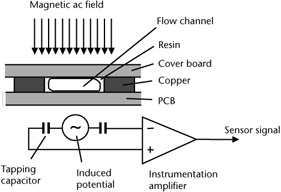
This technique uses the physical principle that an electric potential is developed when a fluid of low conductivity passes perpendicularly through a magnetic filed [102]. By using an ac magnetic field (here 65 kHz), it is possible to extract the electric potential across capacitors formed through plates on both channel sides and an isolating layer. This eliminates the need for electrodes in contact with the fluid. The sensor, however, is limited to applications in conducting fluids. A schematic of the sensor cross-section is given in Figure 9.34.
The sensor is manufactured out of a printed circuit board (PCB) with copper structures and is covered by a glass plate. The PCB is glued to the glass plate with epoxy resin, which also forms the inside walls of the fluidic channels. The resin film protects the board materials against the effects of fluids (e.g., swelling of the board), reduces the influence of toxic copper on the fluid, and isolates the copper structures preventing electrical current flowing between copper and fluid. A potential difference between left and right copper tracks of 5V was applied. The magnetic field strength in the fluidic channel was...