MEMS Mechanical Sensors

9.4: Force Transfer Flow Sensors

9.4 Force Transfer Flow Sensors

9.4.1 Drag Force

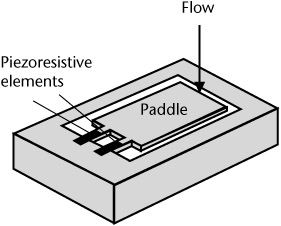
This type of flow sensor consists of a cantilever beam, or paddle, with an integrated strain gauge resistor. When the cantilever is immersed in a flowing fluid, a drag force is exerted resulting in a deflection of the cantilever, which can be detected by the pie-zoresistive elements incorporated in the beam. The figures in the following sections show schematics of devices using this measurement principle.

In-Plane Drag Force Flow Sensors Gass et al. [88], Nishimoto et al. [85], and Zhang et al. [89] presented in-plane paddle flow sensors (Figure 9.24). Zhang proposed that their sensor can have two working modes: drag force and pressure difference. Simulation showed that drag force mode is more suitable for small flow rates (e.g., below 10 ?l/min for water) and pressure difference is more suitable for high flow rates (e.g., above 100 ?l/min for water) [85]. The pressure difference mode is feasible due to the pressure drop through the small gap around the paddle at high flow rates (Figure 9.24), since the pressure drop increases with increasing flow rate. However, the high pressure drop is a disadvantage if the sensor is to be used with other devices as mentioned above. Other disadvantages of this type of flow sensor setup are the disturbance of the flow profile, the sensitivity to particles, and the fragility of the paddle suspension.


Figure 9.24: Schematic of in-plane drag force flow sensors. Zhang et al. [89] use a 10- ?

UNLIMITED FREE
ACCESS
TO THE WORLD'S BEST IDEAS

SUBMIT
Already a GlobalSpec user? Log in.

This is embarrasing...

An error occurred while processing the form. Please try again in a few minutes.

Customize Your GlobalSpec Experience

Category: Turbine Flow Meters
Finish!
Privacy Policy

This is embarrasing...

An error occurred while processing the form. Please try again in a few minutes.