Metal Building Systems: Design and Specifications, Second Edition
Secondary structural members span the distance between the primary building frames of metal building systems. They play a complex role that extends beyond supporting roof and wall covering and carrying exterior loads to main frames. Secondary structurals, as these members are sometimes called, may serve as flange bracing for primary framing and may function as a part of the building s lateral load-resisting system. Roof secondary members, known as purlins, often form an essential part of horizontal roof diaphragms; wall secondary members, known as girts, are frequently found in wall bracing assemblies.
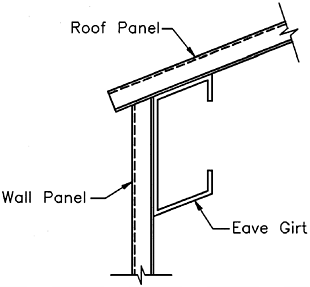
A third type of secondary framing, known by the names of eave strut, eave purlin, or eave girt, acts as part purlin and part girt its top flange supports roof panels, its web, wall siding (Fig. 5.1).
Girts, purlins, and eave struts exhibit similar structural behavior. Since most secondary members normally encountered in metal building systems are made of cold-formed steel, our discussion starts with some relevant issues in design of cold-formed steel structures.